
Stop the wear before it’s too late.
Most convertible roof damage isn’t accidental—it’s mechanical. Whether you drive an Audi, BMW, Mazda, or Porsche, your soft-top is likely under constant stress from specific “Pinch Points” in the folding mechanism that cause friction, heat, and eventual tearing.
This specialist guide identifies the most common transition-zone faults. Our Cabritex™ Precision Repair Patches are engineered to reinforce these high-wear areas, providing a permanent, watertight fix that saves you a £1,000+ full roof replacement bill.
Our Cabritex Repair Patches are the neatest, watertight fix for these 10cm “Friction Zones.”Common Convertible Roof Pinch Points: A Technical Guide
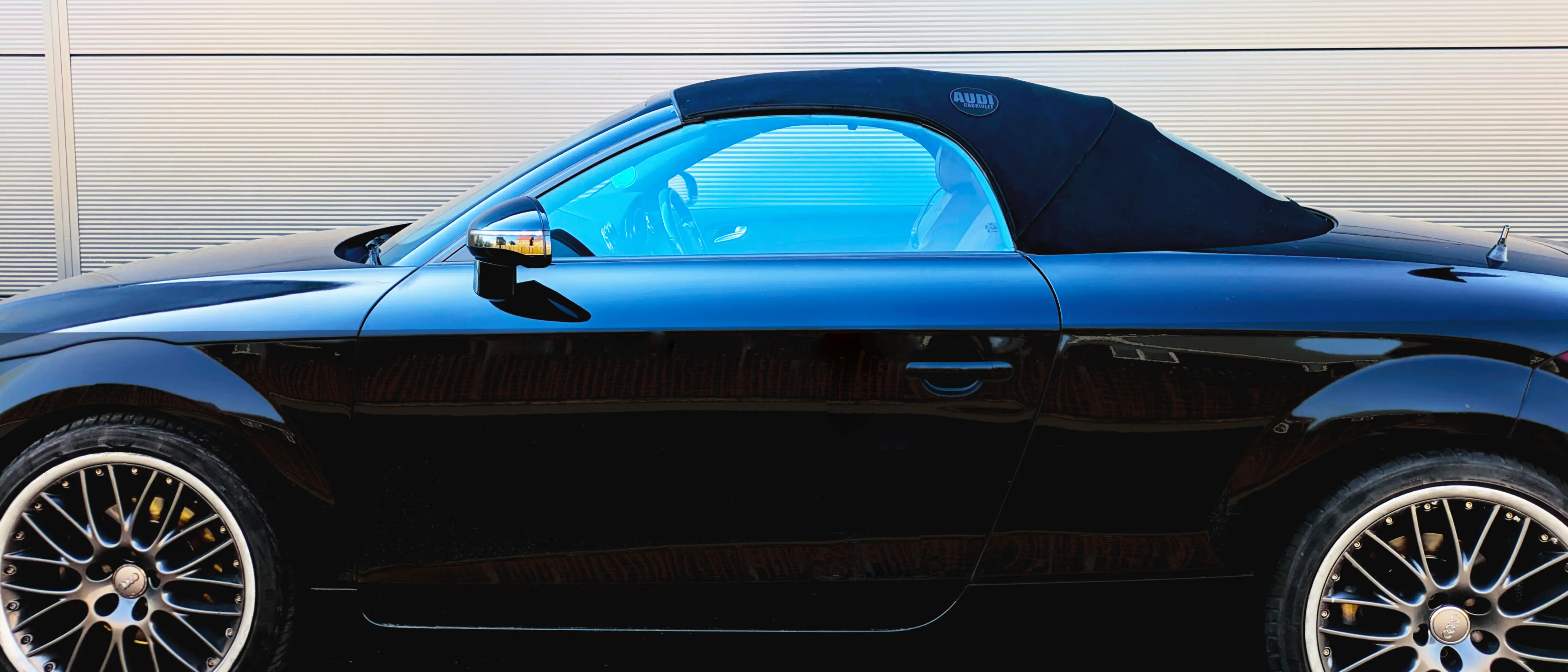
1. Audi TT / A3 / A5 (The Pillar Hinge Snag)
The most common Audi convertible roof problem is a failure in the tensioning straps. When these elasticated cords lose their pull, the fabric doesn’t fold inward properly and gets trapped in the main side-pillar hinge. This mechanical “pinch” creates a specific vertical tear or “shining” friction mark. Our convertible roof repair kit is designed to seal these 4–8cm pillar snags before they become full-thickness holes that leak into the cabin. Audi pinch points and roof stress repair
2. BMW Z4 / 3-Series / 4-Series (Rear Corner Tension Splits)
BMW soft tops often suffer from “timed flap” issues. If the hydraulic roof motor or the wing-flap microswitches are slightly out of sync, the frame puts extreme tension on the rear corners near the glass. This leads to small, jagged stress splits usually under 6cm. Applying a specialized soft top patch to these high-tension corners prevents the internal reinforcement from fraying further and saves the cost of a full roof replacement. BMW convertible roof frame wear
3. Mazda MX-5 NC & ND (Internal Header Rail Rub)
The MX-5 NC and ND models have a documented issue with the internal frame’s header rail screws or plastic joints protruding. As the car vibrates during driving, these hard points “drill” into the canvas from the inside. This starts as a tiny “pinhole” that quickly expands into a 5cm fray. A DIY roof fix using a localized patch is the most effective way to stop this internal abrasion from ruining the outer weather-shield layer. Mazda MX-5 convertible pinch points
4. Porsche Boxster 986 / 987 / 981 (The Z-Fold Crush)
The Porsche “Z-fold” mechanism relies on plastic pushrods to stack the roof flat. If these rods bend or the alignment shifts, the frame “crushes” the fabric against the engine cover lid. This creates a horizontal fabric split along the main fold line. Because these tears are usually thin and under 10cm, they are prime candidates for a structural convertible top repair rather than an expensive mechanical overhaul. Porsche soft top stress area
5. Mercedes SLK / CLK / E-Class (Vario-Roof Edge Fraying)
The Mercedes “Vario” and soft-top mechanisms use a complex series of cables and pivots near the C-pillar. If a cable stretches, the fabric can “catch” on the metal edge of the rear pillar during the stowage cycle. This results in edge fraying and small “nibbled” holes. Promptly sealing these catches with a soft top restoration patch prevents the wind from catching the frayed edges and tearing the roof open at motorway speeds.
6. Jaguar XK / F-Type (Hydraulic Arm Snagging)
Jaguar convertible roofs feature a tight-clearance design where the hydraulic lifting arms sit very close to the inner liner. If the liner sags even slightly, the arm “snags” the fabric during the opening sequence, causing a small, clean “pinch” hole. These snags are usually small and circular, making them the perfect size for a discreet repair patch that restores the waterproof integrity of the Jaguar’s luxury canvas. Jaguar convertible stress tear reinforcement
7. Mini Cooper (Storage Tray Vibration Wear)
The Mini’s unique “sunroof” stage means the fabric often sits partially folded. If the locking pins or storage tray are not perfectly aligned, the roof vibrates against the rear quarters, causing round “balding” wear spots or “chatter marks.” These thinning patches eventually become holes. Using a convertible roof repair kit on these 2-3cm spots early prevents the vibration from eating through the entire multi-layer fabric. Mini Cooper soft top pressure patch
8. Volkswagen Golf & Beetle (Seal Friction Thinning)
On VW convertibles, the rubber weather-stripping seals can become “tacky” or misaligned. When the roof is stowed, these seals rub against the canvas with every bump in the road, creating thinned “friction patches.” These patches eventually crack and leak. A localized waterproof patch reinforces these thinned areas, providing a durable surface that can withstand the constant friction of the rubber seals.
9. Alfa Romeo Spider (Frame Point Abrasion)
The Alfa Spider uses a stylish but complex frame that features several sharp pivot points. Over time, the internal padding shifts, exposing the metal frame to the underside of the canvas. This creates a “pinch” whenever the roof is fully retracted, leading to symmetrical 5cm holes on the shoulders. Identifying these mechanical rub points and applying a reinforcement patch is a vital part of Alfa Romeo soft top maintenance.
10. Range Rover Evoque (Tonneau Cover Pinch)
The Evoque’s wide fabric roof is managed by a series of proximity sensors. If a sensor fails to detect the roof is fully “home,” the heavy rear tonneau cover can close prematurely, pinching the fabric against the side rails. This results in a “crush tear” that is typically 4–9cm long. Our heavy-duty repair patches are ideal for these high-pressure areas, ensuring the Evoque stays watertight without affecting the roof’s sleek profile.
Precision repair patches for all major brands:
Alfa Romeo | Aston Martin | Audi | Austin Healey | Bentley | BMW | Cadillac | Chevrolet | Chrysler | Dodge | Ferrari | Fiat | Ford | Honda | Jaguar | Jeep | Lamborghini | Lexus | Lotus | Maserati | Mazda MX5 | Mercedes | MG | Mini | Morgan | Opel | Peugeot | Porsche | Range Rover Evoque | Renault | Rolls Royce | Suzuki | Toyota | Triumph | Vauxhall | Volkswagen